Accurate tax preparation services start with knowing whether you owe estimated taxes and when each payment is due. If you earn income without automatic withholding, the IRS does not wait until April to collect. It expects payments four times a year, and missing a deadline triggers penalties even if you pay in full at filing.
Estimated taxes allow the IRS to collect income tax throughout the year instead of waiting until annual returns are filed.
At Heritage Accountants & Advisors , we help business owners and individuals across Long Island stay ahead of every quarterly deadline.
You are required to pay estimated taxes if you expect to owe at least $1,000 in federal tax for the year after subtracting withholding and refundable credits, and your withholding covers less than 90% of your current year tax or 100% of your prior year tax.
Self-employed individuals and sole proprietors
Partners in a partnership and S corporation shareholders
Freelancers and independent contractors
Investors earning dividends, capital gains, or rental income
Business owners whose income passes through to personal returns
W-2 employees whose withholding fully covers their liability do not need to make estimated payments. Those with significant side income may still owe them.
According to IRS estimated tax guidance , partners are personally responsible for paying estimated taxes on their share of income, since partnerships do not withhold tax from distributions.
The four 2026 estimated tax payment deadlines are April 15, June 15, September 15, and January 15, 2027.
As of June 22, 2026, the Q1 and Q2 deadlines have passed. The next deadline is September 15, covering income earned from June 1 through August 31.
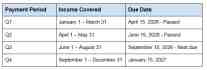
One detail that surprises many business owners is that while Q1 covers three months of income, the Q2 payment period covers income earned only from April 1 to May 31. Many Long Island business owners underestimate Q2 because they assume each payment period covers an equal three-month span of income. At Heritage Accountants & Advisors, we regularly help clients adjust their estimated payments to avoid unexpected underpayment penalties.
Each quarterly payment must be large enough to avoid an underpayment penalty. The IRS calls this the "safe harbor" rule, which lets taxpayers avoid penalties by paying a minimum required amount during the year. Two safe harbor thresholds apply.
The IRS will not charge a penalty if you pay either:
90% of your current year tax liability, or
100% of your prior year tax liability (110% if prior year AGI exceeded $150,000)
Meeting either safe harbor threshold can help you avoid an underpayment penalty. Many business owners use the prior-year safe harbor because it is easier to calculate mid-year. Many begin business tax preparation planning in Q4 of the previous year, so estimated payments can be projected before the new tax year begins.
The IRS calculates underpayment penalties separately for each missed quarter, with interest accruing from the due date until payment is made. Paying your full tax bill in April does not eliminate those penalties. CPA tax preparation services that include quarterly planning can help business owners avoid unexpected costs.
New York generally requires estimated tax payments if you expect to owe more than $300 in New York income tax after withholding and credits. Working with tax preparation services in Long Island can help business owners stay current with both federal and state estimated tax obligations.

The Q3 estimated tax payment is due September 15, 2026, covering income earned from June 1 through August 31. With Q1 and Q2 now closed, this is the next opportunity to stay current and avoid compounding penalties.
As income tax provisions experts in Long Island , Heritage Accountants & Advisors works with closely held businesses and individuals across the region to review income projections, calculate quarterly obligations, and file on time. Call (631) 543-7700 or email info@heritage.cpa to schedule a consultation before September 15.
Note: Tax laws are subject to change and individual situations vary. This information is for educational purposes and does not constitute professional tax advice. Please consult with a qualified accountant regarding your specific tax obligations.