Small businesses should keep records that document income, deductions, expenses, credits, payroll activities, and asset purchases or other property transactions that affect tax reporting. At Heritage Accountants & Advisors , we see this gap cost Long Island owners real money every tax season. If you cannot substantiate a deduction, you lose it. Missing records do not just create stress; they create tax liability.
The IRS does not require any specific kind of records. Any system that clearly shows your income and expenses works. What matters is that the right categories are covered consistently. Small business accounting services help you identify exactly which categories your business needs to cover consistently.

If your business maintains inventory, your records should track gross receipts, inventory purchases, inventory on hand, merchandise withdrawn for personal use, and related business expenses.
Gross receipts include all income your business receives. Keep:
Bank deposit slips
Cash register tapes
Sales invoices
Credit card transaction summaries
Track what you buy to resell or use in your business. Keep canceled checks, invoices, credit card statements, transaction records, and other proof of payment showing what you paid for inventory or supplies.
Save receipts, proofs of purchase, canceled checks, or account statements for each business expense. This covers rent, utilities, supplies, and professional fees.
Travel and meals require extra documentation. Travel, transportation, and gift expenses follow IRS guidelines in IRS Publication 463 to meet additional recordkeeping rules for these expenses.
There are specific employment tax records you must keep. Keep all records of employment for at least seven years to ensure compliance with federal and state regulations.
Payroll records include:
Employee W-4 forms
Wage payment records
Federal and state tax withholding documentation
Hours worked and compensation paid
If your business owns property, equipment, or vehicles, keep records that support depreciation calculations. Keep records relating to property until the statute of limitations expires for the tax year in which you sell, exchange, or otherwise dispose of the property. You must keep these records to figure any depreciation, amortization, or depletion deduction, and to figure your basis for computing gain or loss when you sell or otherwise dispose of the property.
Supporting documents include sales slips, paid bills, invoices, receipts, deposit slips, and canceled checks. These documents contain the information you need to record in your books.
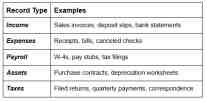
Here is a quick reference table:
Yes. All requirements that apply to hard copy books and records also apply to electronic records. Your electronic system must reproduce legible records on request. Many modern accounting and cloud-based recordkeeping platforms are designed to meet these requirements when properly configured and maintained.
Our CPA bookkeeping services include setting up and maintaining digital recordkeeping systems designed to support IRS recordkeeping requirements throughout the year.
Do I need to keep personal and business records separate?
Yes. Keeping personal and business records separate is strongly recommended and helps support accurate tax reporting.
Separate business accounts and records make it easier to document income and expenses and respond to IRS inquiries.
What if I lose a receipt?
A bank or credit card statement showing the charge can substitute in some cases. However, for larger deductions,
additional documentation is strongly recommended.
Do corporations have extra requirements?
Yes. A corporation should keep minutes of the board of directors' meetings. These are required records that sole
proprietors and partnerships do not need.

Good records are the foundation of accurate tax filings, clean audits, and informed business decisions. Heritage Accountants & Advisors’ CPA accounting services in Long Island help you build and maintain a recordkeeping system that works for your business from day one.
We use IRS Publication 583 as a foundation and tailor our recordkeeping approach to your business needs. Proper records help reduce errors, support tax compliance, and simplify financial management.
Call Heritage Accountants & Advisors at (631) 543-7700 or email info@heritage.cpa to learn more about our accounting and bookkeeping services in Long Island .
Disclaimer: This content provides general information and does not constitute professional tax or legal advice. Please consult with a qualified tax professional regarding your specific business needs.