Most Long Island businesses benefit from retaining tax and financial records for at least seven years. While the IRS generally has three years to assess additional tax and six years in cases involving substantial underreporting of income, certain records may need to be retained longer depending on their purpose and applicable federal or New York State requirements. At Heritage Accountants & Advisors , missing or disorganized records are one of the most common problems we see during IRS inquiries, and they can cost a business its legitimate deductions.
Here is what you need to keep, and for how long.

The IRS requires businesses to keep records as long as they may be needed to administer any provision of the Internal Revenue Code. In practice, that means three years for most filed returns, six years if more than 25% of gross income is omitted, and an unlimited period when a fraudulent return is filed, or no return is filed.
IRS Publication 583 outlines these requirements directly for small business owners.
For businesses using CPA accounting services in Long Island , your CPA tracks these timelines. But the records themselves are your responsibility to maintain.
New York generally requires businesses to retain tax records for at least three years after filing a return. Certain records may need to be retained longer if they become subject to audit, litigation, or other proceedings. Because businesses often maintain records needed for both federal and state purposes, many advisors recommend a seven-year retention policy as a practical safeguard.
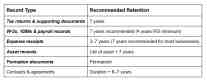
Depreciation records require special attention. Per IRS Publication 946, asset records must be kept for the entire period an asset is in service, plus the audit window after disposal.
Corporate records for LLCs and S corporations, including articles of organization, operating agreements, and meeting minutes, should be kept permanently. These are the legal foundations of your business entity.
Keep payroll records for at least seven years. The U.S. Department of Labor requires three years under the Fair Labor Standards Act, and the IRS recommends four years for employment tax records. Seven years aligns both timelines under a single, manageable policy.
Records to retain include:
Employee names, Social Security numbers, and addresses
Hours worked and rates of pay
Payroll tax filings (Forms 941 and 940)
New York State unemployment tax filings
Workers' compensation documentation
Businesses using accounting and bookkeeping services in Long Island should confirm their payroll records are stored securely and consistently, whether in paper or digital format.
Yes, once the retention period has passed and no audits, disputes, or litigation are pending. Shred paper records with sensitive data. Permanently delete digital files.
Confirm with your CPA before discarding anything. A routine cleanout becomes a serious problem if a claim surfaces shortly after.
A practical system has two components: a written retention schedule and secure storage. At Heritage Accountants & Advisors, we recommend:
A written schedule listing each record type and its retention period
A Cloud-based accounting software
Backups in at least two locations
One designated records custodian in your business
An annual review of your retention policy
Record retention is not a one-time setup. Tax law changes, and your business structure may shift over time. Our
CPA bookkeeping services
cover bookkeeping, financial statement preparation, and recordkeeping guidance. We help you stay current without
adding to your administrative load.
Does New York State have different retention rules than the IRS?
New York State Department of Taxation and Finance mirrors the federal three-year window, but applies its own timelines
for sales tax. Seven years covers both safely.
Is digital storage acceptable to the IRS?
Yes, provided records are accurate, complete, and accessible. IRS Revenue Procedure 98-25 covers the standards.
What if records were destroyed in a disaster?
Document the loss immediately, gather available bank, payroll, vendor, and tax records, and begin reconstructing
records as soon as possible. A CPA can assist with rebuilding documentation needed for tax and insurance purposes.

Protecting your records protects your business. Heritage Accountants & Advisors delivers small business accounting services in Long Island , designed to keep your records audit-ready. Call (631) 543-7700 or email info@heritage.cpa to review your current recordkeeping practices.
Disclaimer: This content is for informational purposes only and does not constitute professional tax, legal, or accounting advice. Record retention requirements can vary based on specific business circumstances. Please consult with a qualified CPA or legal professional regarding your specific business needs.